Defects
Defects are very important and have a large impact on the various properties of materials. It is one of the main components along with bonding and crystal structure that determine the properties. There is no such thing as a perfect crystal—there will always be defects. There are many kinds of defects that can be divided into these four categories:
- 0D – Point Defects: This includes atoms that are missing or that are in irregular places in the lattice (lattice vacancies, substitutional and interstitial impurities, self-interstitials)
- 1D – Linear Defects: Groups of atoms in irregular positions ( screw and edge dislocations)
- 2D – Planar Defects: The interfaces between homogeneous regions of the material (e.g. grain boundaries, stacking faults, external surfaces)
- 3D – Volume Defects: Cracks, pores, or other extended defects.
Point Defects
Today, we will look specifically at point defects. The main types include:
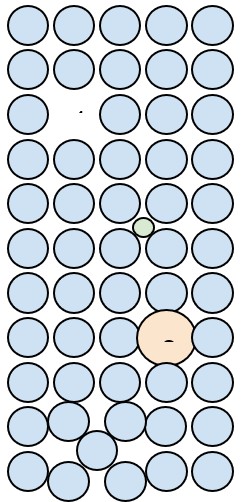
1. Vacancy -- This is when there are atoms missing from lattice sites which causes a distortion of planes and missing bonds. Vacancies have a high cost of energy that comes from thermal energy. \( Q_V \) is the activation energy needed to form a vacancy. We can use the following equation to find the number of vacancies present:
Where \( N_v \) is the number of vacancies, \( N \) is the number of lattice sites, and \( k \) is the boltzmann constant.
2. Interstitial Impurity -- Smaller atoms that fit into the vacancies between lattice atoms.
3. Substitutional Impurity -- An atom of a different type replaces one of the bulk atoms. Sizes are usually similar.
4. Self-interstitial -- An atom from the crystal is forced into a small void, distorting the surrounding lattice. Though rare, they follow the same equilibrium equation with a smaller activation energy: \( N_i = N , e^{-Q_i / kT} \).
Point Defects in Ionic Solids
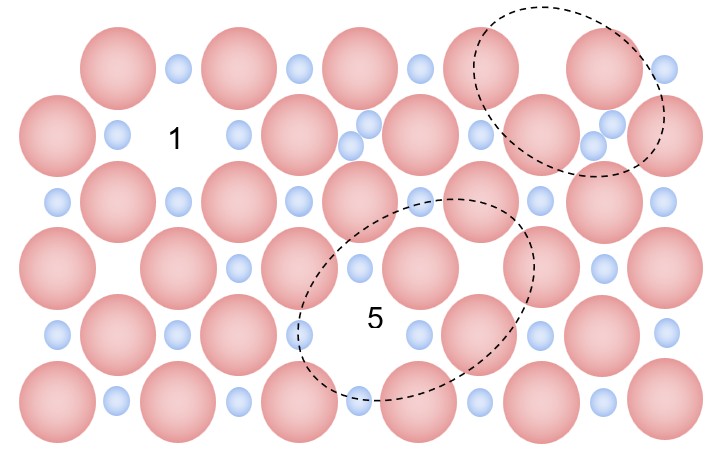
In Ionic solids, charge neutrality must be maintained. Because of this, these are the defects that can occur :
- Anion vacancy
- Cation vacancy
- Cation interstitial
- Frenkel defect
The Frenkel defect can be thought of as a cation leaving its normal place and moving into an interstitial site. - Schottky defect
The schottky defect is a cation vacancy - anion vacancy pair.
Point Defects Practice Problems
-
Calculate the equilibrium number of vacancies for a cubic centimeter of copper at 1000 ° C given :
\( Q_{v} \) = 0.9 eV/atom
Atomic mass = 63.5 g/mol
d = 8.4 g/cm3
k = 8.34 × 10⁻⁵ eV/K
hint : N = Volume × density × Avogadro's Number ÷ atomic mass - The equilibrium fraction of lattice sites that are vacany in silver at 700 ° C is 2 × 10⁻⁶. Calculate the number of vacancies per meter cubed at this temperature. Assume a density of 10.35 g/cm3.
- Calculate the fraction of lattice sites that are Schottky defects for cesium chloride at 645 ° C. Assume an energy for defect formation of 1.86 eV.
Line Defects
Line defects can also be known as dislocations that happen in the crystal lattice. These dislocations produce a permanent plastic deformation. They are also the reason why metals are able to bend.
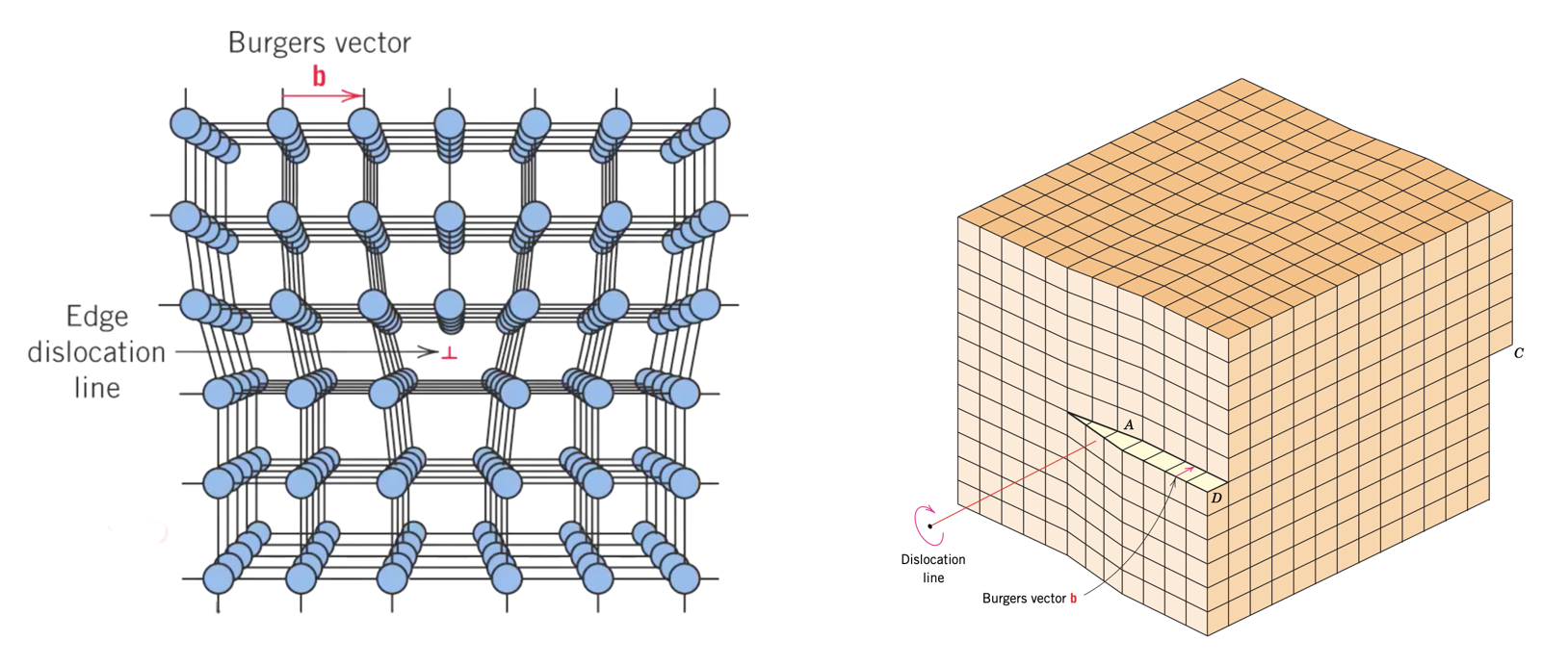
The first type of dislocation we will look at is the edge dislocation. An edge dislocation is a linear defect that centers around a line defined along the end of an extra plane of atoms. This is going to be denoted by \( \bot \) or \( \top \) with the end pointing to the extra plane of atoms. This can be seen in the image below on the left hand side.
The second type of dislocation is called a screw dislocation. This is when the atoms are shifted by one atomic distance. The image is similar to that of a spiral staircase and can be seen in the image below to the right. Most crystals have what is called a mixed edge screw dislocation where the screw travels over from one edge to the other.
Next we will look at the planar defects. There are 4 primary planar defects:
- Surfaces and Interfaces
First, surface atoms are at a higher energy state due to their dangling bonds. Active sites on catalysts are generally surface defects as catalysts with larger surface areas move faster. - Grain boundaries
These are 2D defects that occur when grains do not line up correctly meaning that the crystals have different crystallographic orientations within a polycrystalline material. These boundaries can have a lot of effects. They are good places for fractures, they interrupt dislocations, they scatter or inhibit electrons, and they can also diffuse atoms more easily.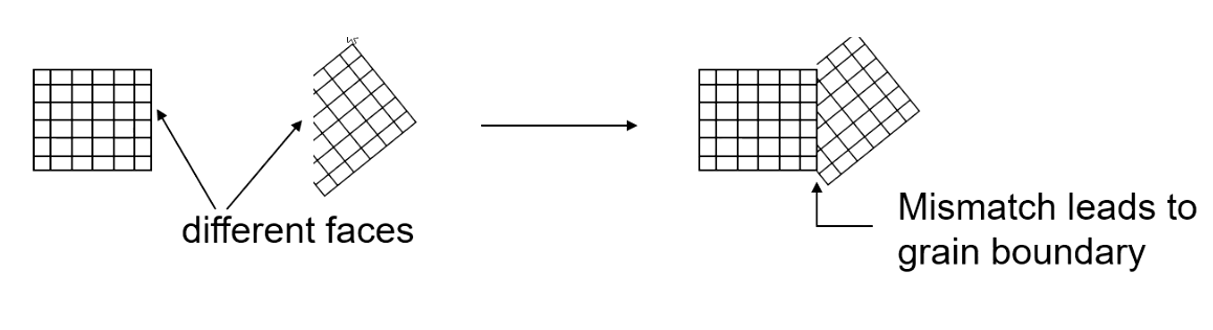
- Twins
A twin boundary is a type of grain boundary that occurs when two crystals of the same type intergrow so that there is only a small misorientation between them. It generally highly symmetrical .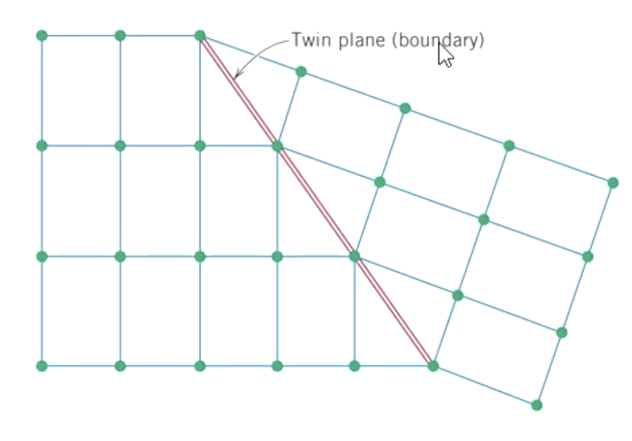
- Stacking faults
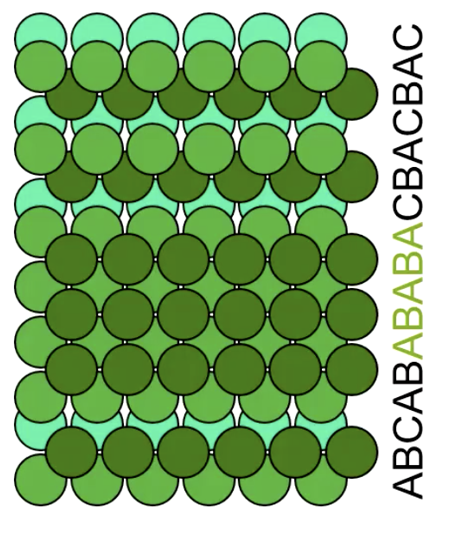
This is where the sequence of layers is not consistent. For example a crystal that may follow ABCABCABC may switch to ABABAB and then back to ABCABCABC.