Diffusion
Today we will go over how we apply diffusion in materials science. First, what is diffusion? We can demonstrate this phenomenon using something called a diffusion couple. This is what happens when you join two bars of different metals together. The process can be seen in the illustration below, where after some time the boundary between the two has been blurred.
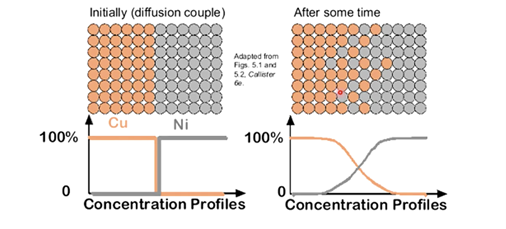
One process that uses diffusion is called case hardening. An example we might look at is a steel case hardened gear. This is done by diffusing carbon atoms into iron atoms at the surface in order to make it harder. The diffusion causes the material to be hard to deform as the Carbon atoms “lock” the planes in place from shearing. It also makes the material difficult to crack as the atoms put the surface in compression. The carbon is just diffused a couple mm into the surface.
Another example of diffusion is doping. This is used for semiconductors. For example, silicon is a very bad conductor, so we can deposit either phosphorus or boron onto the surface in order to change its electrical properties. Once it is heated, the Phosphorus or Boron layers diffuse into the silicon.
Fick's First Law
Since diffusion is a time dependent process, we often want to find out how long something will take or the rate of mass transfer, diffusion flux. Fick’s first law represents something in steady-state, where the diffusion flux does not change with time:Where:
Fick's Second Law
Fick’s second law is used for non-steady state. Where the concentration is not fixed at both ends and can vary with time. Its more practical, seen above in case-hardening and the silicon doping. For this equation there are several conditions that must be met:
- We must have a semi-infinite solid (the diffusing species never sees the end of the material) and it must have a fixed concentration.
- We must have a uniform \( C_0 \), background concentration prior to diffusion.
- \( x \) goes from 0 to infinity (semi-infinite).
- \( C = C_0 \) for all \( t \).
- \( C = C_s \text{ at } x=0 \text{ for all } t \) (surface concentration).
- \( C_x \) = concentration at \( x \) at \( t \).
Yielding:
Where:
Some things to remember:
Diffusion is FASTER for:
- Open crystal structures
- Lower melting temperature materials
- Materials with secondary bonding
- Smaller diffusing atoms
- Lower density materials
Diffusion is SLOWER for:
- Close-packed structures
- Higher melting temperature materials
- Materials with covalent bonding
- Larger diffusing atoms
- Higher density materials
Practice Problems
Boron atoms are to be diffused into a silicon wafer using both predeposition and drive-in heat treatments; the background concentration of B in this silicon material is known to be \( 1 \times 10^{20} \) atoms/m\( ^3 \). The predeposition treatment is to be conducted at 900°C for 30 min; the surface concentration of B is to be maintained at a constant level of \( 3 \times 10^{26} \) atoms/m\( ^3 \). Drive-in diffusion will be carried out at 1100°C for a period of 2 hours. For the diffusion coefficient of B in Si, values of \( Q_d \) and \( D_0 \) are 3.87 eV/atom and \( 2.4 \times 10^{23} \) m\( ^2 \)/s, respectively.
- Calculate the value of \( Q_0 \).
- Determine the value of \( x_i \) for the drive-in treatment.
- Determine the concentration of boron atoms at a position \( 1\,\mu\text{m} \) below the surface.