Polymers
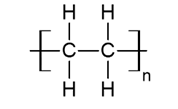
What are polymers? The generic term for polymers is “plastics”, but they can be anything from food containers, to carpets, to transportation elements, etc. Polymers when broken down means “many parts”. It is a chain of repeating “mer” units that are put together with covalent bonds. With polymers they are typically shorthanded into parentheses with an “n” or degree of polymerization indicating how many repeating units there are on the bottom right.
For example:
Common polymers and recyling codes are:
- PET: Polyethylene terephthalate
- HDPE: high-density polyethylene
- PVC: Polyvinyl chloride
- LDPE: low-density polyethylene
- PP: Polypropylene
- PS: Polystyrene
- PTFE: Polytetrafluoroethylene
In recyclable polymers, though the covalent bonds hold the monomers together, the chains of polymers are held together by secondary bonds, which is what makes them recyclable. When the temp is heated over the “glass transition temperature”, aka the temperature where the secondary bonds break and allow chains to slide past each other, the polymers can be broken down and then recycled.
Polymerization is the definition of adding monomers into a polymer. This can be done by chain growth polymerization, which is a technique where monomers grow one at a time onto an active site of a polymer chain. This can be shown as something like \( R' + M \rightarrow R-M' \). It can also be done by step growth, where there are monomers with reactive functional groups that react and form a new small molecule. Step growth can be seen as something like \( A-A + B-B \rightarrow A-AB-B \).
The molecular weight of a polymer is something that is important and interesting as most of the time, many lengths of polymers will be different, therefore they will all have different molecular weights. Because of this, we look at the number average, or \( M_N \). \( M_N = \sum x_i M_i \), where \( x_i \) is the number fraction of the chains, and \( M_i \) is the molecular weight of section \( i \). There is also something called the molecular weight average, or \( M_w \), where \( M_w = \sum w_i M_i \). Where \( w_i \) is the weight fraction of the chains. In a large sample, we look at something called the polydispersity, which is done by dividing the weight average by the number average. This is always larger than or equal to 1.
Practice Problems 1
-
Given polypropylene with a number-average molecular weight of 1,000,000 g/mol, compute the following:
- What is the "mer" of PP?
- Using the "mer", calculate the molecular weight of PP.
- Find the number-average degree of polymerization (hint: use the number-average molecular weight and the number from part b).
Structure of Polymers
Now we will look at the structures of polymers, and polymer crystallinity. Polymers can be arranged in many different ways. For example, polyvinyl fluoride has completely random arrangement, there is no set pattern in the arrangement. On the other hand PMMA has exclusively head to tail arrangement due to its large sidegroup.
Stereoisomerism is where molecules have the same formula and sequence, but differ in orientations. Some examples can be seen below:
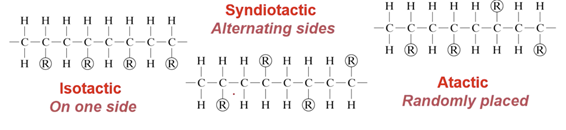
Note: you cannot switch from one to another as bonds must be broken. In terms of polymer structure, there are many different structures:
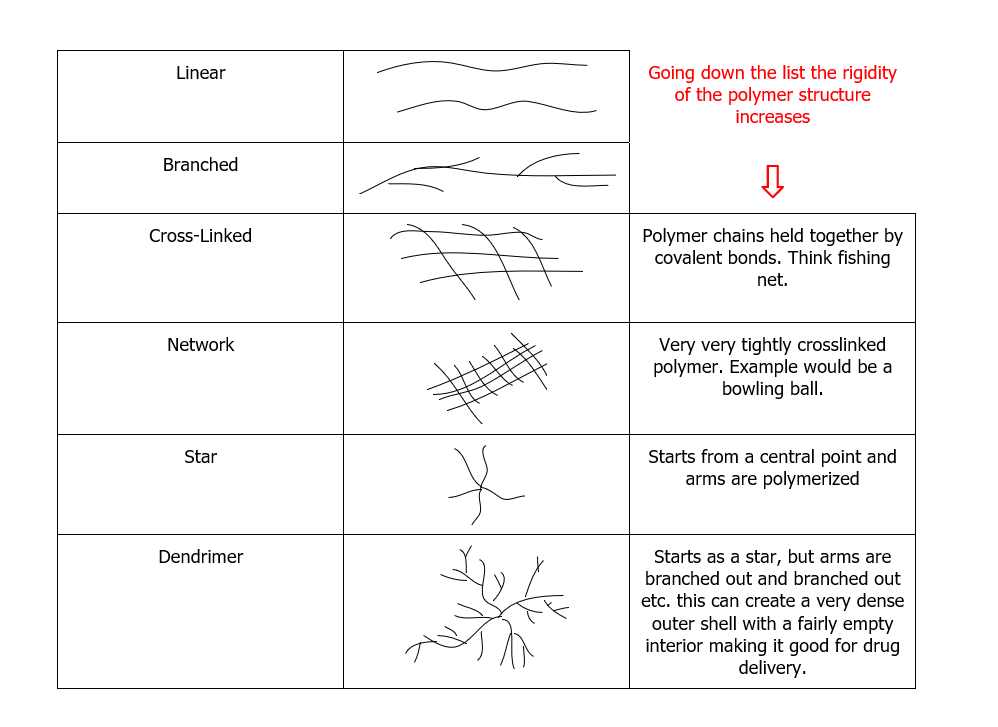
Two large classes of polymers are Thermoplastic and Thermoset. Thermoplastic is where the chains are held together with secondary forces and they are recyclable. Thermoset are covalently bonded, crosslinked polymers. These cannot be recycled as they will fall apart when heated up.
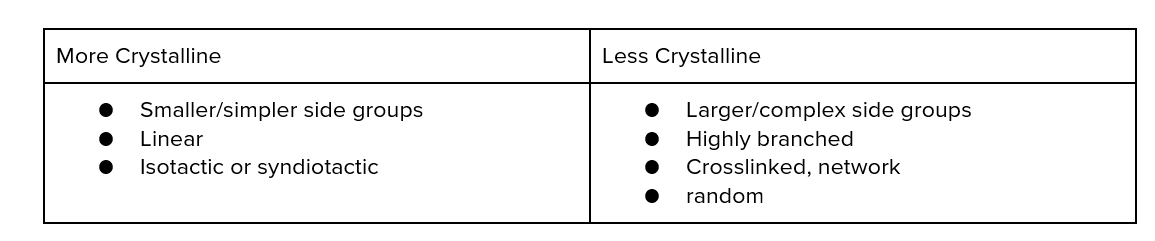
Typically, since polymers are made up of very large chains, it is difficult to have a regular pattern so there can be regions of crystals and amorphous regions in the same polymer sample.
Crystallinity depends on processing conditions and chain configuration:
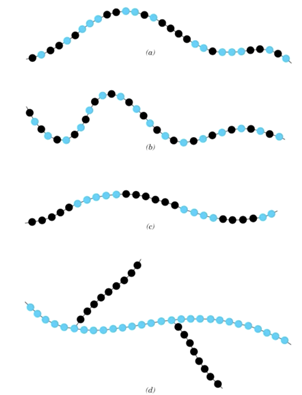
Copolymers are polymers that are made out of 2 or more monomers. There are 4 main types: (a) Random, (b) Alternating, (c) Blocked, and (d) Grafted. These can be seen below.